Is Millboard Worth the Investment? An Honest Look at Cost and Long-Term Value
Millboard is known for its remarkably realistic timber appearance and unique performance characteristics. At the same time, one thing is immediately clear: it is a premium investment.
So it's perfectly reasonable to ask why Millboard decking sits at the higher end of the market. And, more importantly, is Millboard really worth the price?
To answer that question properly, you need to look beyond the initial price per square metre and consider the total cost and value over the product's entire lifespan.
To understand why Millboard costs more than many conventional decking products, it helps to understand what makes it different. Millboard is neither solid timber nor traditional wood-plastic composite (WPC).
Millboard is completely wood-free and manufactured using natural minerals, fibre reinforcement and a polymer resin system containing partly renewable biopolymers. This core is covered with a resilient Lastane® surface, designed for durability and excellent slip resistance.
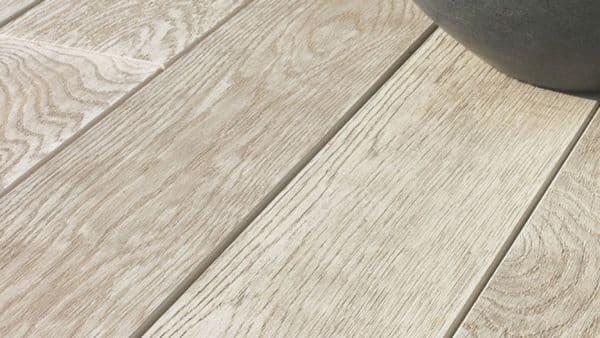
Each board is also moulded from carefully selected pieces of real oak and hand-finished with a specific colour treatment. This creates an exceptionally realistic timber appearance, without many of the disadvantages associated with natural wood.
How Much Does Millboard Decking or Cladding Cost in 2026?
The final investment depends on the collection and colour selected, the construction of the subframe and any edging or finishing details required. As a guide, the following prices per square metre apply, including VAT:
Millboard Decking Prices per m²
Enhanced Grain | Premium color variants: €265 per m²
Enhanced Grain | other colours: €245 per m²
Weathered Oak | Embered: €270 per m²
Weathered Oak | Driftwood & Vintage: €255 per m²
Modello | Linear & Contour: €305 per m²
Matching recycled plastic subframe joists, including screws: from €30 per m²
Millboard Cladding Prices per m²
Envello Shadow Line: €295 per m²
Envello Board & Batten: €360 per m²
Enhanced Grain: €255 per m²
Weathered Oak: €255 per m²
Which Costs More: Timber, Composite or Millboard?
If you compare materials purely by their initial purchase price, the hierarchy is relatively straightforward.
Pressure-treated softwood is generally the least expensive option, followed by standard WPC composite and premium hardwood. Millboard sits at the upper end of the market and requires a higher initial investment.
At first glance, timber or conventional composite decking may therefore appear more attractive from a budget perspective. But a deck or façade isn’t designed for just one or two seasons. Ideally, you’re making a decision for the next 25 to 30 years. Over that period, the comparison starts to look very different.
Initial Cost Versus Long-Term Cost
A timber deck requires ongoing maintenance. Depending on the type of timber and the desired appearance, this can include specialist cleaning, sanding, oiling or staining.
Over a period of 20 years, the cost of stains, oils, brushes, cleaning products and the labour involved can add up to hundreds or even thousands of euros.
With Millboard, these recurring treatments aren’t necessary. There’s no need for oil or stain, and sanding or impregnating the boards becomes a thing of the past.
For routine maintenance, warm soapy water and a soft brush are usually enough to keep your decking looking fresh. Millboard is designed not to rot or splinter and offers a long service life. When you factor in reduced maintenance, fewer treatments and the time saved over many years, the higher initial investment can become considerably more attractive over the full life of the deck.
Everyday Comfort and Quality
Of course, the decision isn’t purely about financial return. Much of Millboard’s value becomes apparent in everyday use.
Its resilient surface provides high levels of slip resistance, including in wet conditions. Because the surface is non-porous, everyday dirt and spills are easier to clean and are less likely to penetrate the material.
And because Millboard contains no timber, it won’t splinter like natural wood can—making it comfortable to walk on barefoot during warm summer days.
These practical benefits are difficult to express in a simple price-per-square-metre comparison, but they can make a significant difference over the years.
A Long-Term Investment in Your Outdoor Space
If you’re simply looking for the lowest possible upfront cost, Millboard probably won’t be the most obvious choice.
But if you’re looking for a premium, low-maintenance and highly slip-resistant solution that combines the appearance of timber with long-term performance, the calculation becomes very different.
The initial investment may be higher, but the combination of minimal maintenance, durability, everyday comfort and a realistic timber appearance means you’re investing in much more than the boards themselves.
You’re investing in an outdoor space designed to be enjoyed for many years to come.
This remnant stock has only been used for five days at a trade fair. The boards have not been screwed down, so they are still completely new. However, the floor is dirty and needs to be cleaned with soap and water before use. Includes fastening materials, transport with forklift truck, and VAT. Matching substructure available at extra cost.
Normal retail price: €12,500
Special offer price: €6,250